

NCERT Class 7 Social Science Book – Exploring Society: India and Beyond PDF Download
Social Science in Class 7 helps students understand the world around them — from India’s geography and climate to its history, culture, government, and economic systems.
The NCERT Class 7 Social Science textbook is called Exploring Society: India and Beyond. Unlike older Social Science books that were divided separately into History, Geography, Civics, and Economics, this new textbook brings all these subjects together through connected themes.
The book encourages students to understand how people, places, societies, and systems are connected. It focuses on developing curiosity, reasoning skills, and awareness about India and the wider world.
The textbook is divided into Part 1 and Part 2, covering topics like India’s geographical diversity, ancient history, cultural heritage, democracy, money, markets, farming, infrastructure, and finance.
On this page, you will find the complete NCERT Class 7 Social Science Exploring Society India and Beyond PDF chapter-wise, along with a short explanation of every chapter.
Part 1
Download NCERT Class 7 Social Science Part 1 – Chapter Wise PDF
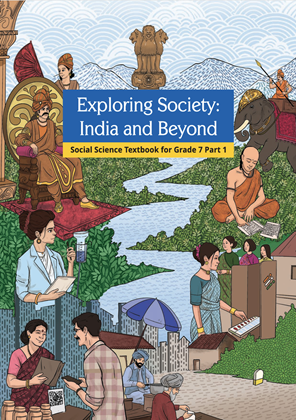
Chapter 1: Geographical Diversity of India
Chapter 2: Understanding the Weather
Chapter 4: New Beginnings: Cities and States
Chapter 5: The Rise of Empires
Chapter 6: The Age of Reorganisation
Chapter 7: The Gupta Era: An Age of Tireless Creativity
Chapter 8: How the Land Becomes Sacred
Chapter 9: From the Rulers to the Ruled: Types of Governments
Chapter 10: The Constitution of India — An Introduction
Chapter 11: From Barter to Money
Chapter 12: Understanding Markets
Part 2
Download NCERT Class 7 Social Science Part 2 – Chapter Wise PDF
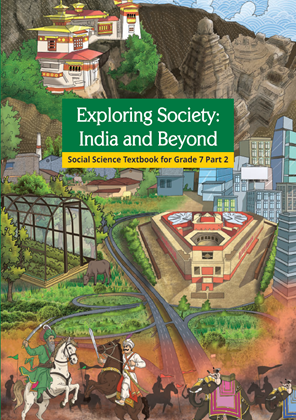
Chapter 1: The Story of Indian Farming
Chapter 2: India and Her Neighbours
Chapter 3: Empires and Kingdoms: 6th to 10th Centuries
Chapter 4: Turning Tides: 11th and 12th Centuries
Chapter 5: India, a Home to Many
Chapter 6: The State, the Government, and You
Chapter 7: Infrastructure: Engine of India’s Development
Chapter Wise Details
Part 1
Chapter 1: Geographical Diversity of India
This chapter introduces students to the physical diversity of India. It explains different landforms such as mountains, plains, plateaus, deserts, coasts, and islands.
Students learn how geography affects people’s lifestyle, agriculture, settlements, and occupations.
Chapter 2: Understanding the Weather
This chapter explains the basics of weather and its elements like temperature, rainfall, humidity, and wind.
Students understand how weather changes and how it affects daily life.
Chapter 3: Climates of India
This chapter focuses on India’s climate and the factors that influence it.
Students learn about seasons, monsoon patterns, rainfall distribution, and how climate affects agriculture and human activities.
Chapter 4: New Beginnings: Cities and States
This chapter introduces students to the development of early cities and states in India.
It explains how settlements grew, how societies changed, and how organised systems developed.
Chapter 5: The Rise of Empires
This chapter explores the growth of powerful kingdoms and empires in ancient India.
Students learn about administration, culture, trade, and the expansion of political systems.
Chapter 6: The Age of Reorganisation
This chapter explains the changes that happened after major ancient empires declined.
Students learn about the emergence of new kingdoms, regional powers, trade, and cultural developments.
Chapter 7: The Gupta Era: An Age of Tireless Creativity
This chapter highlights the Gupta period and its contributions to science, mathematics, literature, art, and culture.
Students understand why this period is considered important in Indian history.
Chapter 8: How the Land Becomes Sacred
This chapter explains the relationship between geography, culture, traditions, and sacred places.
Students learn how rivers, mountains, and landscapes become connected with cultural beliefs and practices.
Chapter 9: From the Rulers to the Ruled: Types of Governments
This chapter introduces different forms of government.
Students learn about monarchy, democracy, and other systems, and understand how governments function.
Chapter 10: The Constitution of India — An Introduction
This chapter introduces the Indian Constitution and explains its importance.
Students learn about democracy, rights, duties, and the principles that guide the country.
Chapter 11: From Barter to Money
This chapter explains the evolution of trade systems.
Students learn how people moved from exchanging goods through barter to using money for buying and selling.
Chapter 12: Understanding Markets
This chapter explains how markets work and how goods and services move between producers and consumers.
Students understand basic economic activities and the role of markets in daily life.
Part 2
Chapter 1: The Story of Indian Farming
This chapter explains the importance of agriculture in India.
Students learn about farming methods, crops, farmers’ lives, and how agriculture has changed over time.
Chapter 2: India and Her Neighbours
This chapter introduces India’s neighbouring countries and explains historical, cultural, and geographical connections.
Students understand how countries interact with each other.
Chapter 3: Empires and Kingdoms: 6th to 10th Centuries
This chapter explores kingdoms and empires that developed between the 6th and 10th centuries.
Students learn about rulers, administration, culture, and achievements of this period.
Chapter 4: Turning Tides: 11th and 12th Centuries
This chapter explains important changes in Indian history during the 11th and 12th centuries.
Students learn about political developments and changing societies.
Chapter 5: India, a Home to Many
This chapter focuses on India’s diversity and different communities.
Students learn how different languages, traditions, and cultures together form India’s identity.
Chapter 6: The State, the Government, and You
This chapter explains the relationship between citizens and government.
Students learn about government functions, responsibilities, and the importance of participation.
Chapter 7: Infrastructure: Engine of India’s Development
This chapter explains the importance of infrastructure like transport, communication, electricity, and public facilities.
Students understand how infrastructure supports economic growth.
Chapter 8: Banks and the Magic of Finance
This chapter introduces students to banking and financial systems.
Students learn about saving money, banks, loans, and the importance of financial awareness.
Why Use NCERT Books for Class 7 Social Science?
Many students find Social Science difficult because it contains history, geography, civics, and economics together. NCERT makes learning easier because:
Concepts are connected
The book explains how geography, history, society, and economy influence each other.
School exams follow NCERT
Most school questions are based on textbook concepts, activities, and exercises.
Easy explanation style
Topics are explained with examples instead of only memorising facts.
Updated curriculum
Exploring Society follows the latest NCERT approach for integrated Social Science learning.
Frequently Asked Questions
How many chapters are there in NCERT Class 7 Social Science Exploring Society India and Beyond?
There are 20 chapters in total — 12 chapters in Part 1 and 8 chapters in Part 2.
Is Exploring Society India and Beyond the new NCERT Class 7 Social Science book?
Yes, it is the revised integrated Social Science textbook for Class 7.
Are NCERT Class 7 Social Science PDFs free?
Yes, NCERT textbooks are available free for students.
Do I need separate History, Geography, and Civics books?
No, this textbook combines these subjects into one integrated Social Science book.
Where can I find Class 7 Social Science solutions?
You can visit our NCERT Solutions for Class 7 Social Science page for chapter-wise answers.
Closing Note
At Invincible Edge Academy, we keep our NCERT book pages updated according to the latest textbooks so students always get the correct and complete study resources.
Use this page throughout the year for learning, revision, homework, and exam preparation. Bookmark it and explore the society around you with a better understanding.