

Related Links
-
NCERT Class 9 Maths Book Ganita Manjari Part 2 - PDF Download
-
NCERT Class 9 Social Science New Book PDF 2026-27 – Chapter Wise Download
-
NCERT Class 9 Hindi Book – Ganga PDF Download (New 2026-27 Edition)
-
NCERT Class 9 English Book – Kaveri PDF Download (2026-27)
-
NCERT Class 9 Science Book – Exploration PDF Download (2026-27) | All Chapters Free
-
NCERT Class 9 Maths Book Ganita Manjari - PDF Download
NCERT Class 9 Maths Book – Ganita Manjari Part 1 PDF Download (2026-27) | All Chapters Free
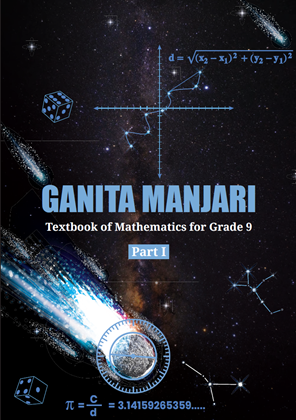
If you’re looking for the Class 9 Maths NCERT book for the 2026-27 session, the book you need is no longer the old one. The new textbook is called Ganita Manjari Part 1 — and it’s a significant departure from everything Class 9 Maths used to look like.
The old book had 12 chapters. This one has 8. But don’t let that fool you into thinking it’s lighter — the chapter titles alone tell you something has shifted. “The Mathematics of Maybe.” “I’m Up and Down, and Round and Round.” “Predicting What Comes Next?” These aren’t the flat, topic-named chapters students are used to. They reflect a book that actually wants you to think, not just calculate.
This page has all 8 chapters of Ganita Manjari Part 1 available as free PDF downloads — chapter-wise, straight from the official NCERT source. No broken links, no outdated editions.
Download Chapter-wise PDFs — Ganita Manjari Part 1:
What Is Ganita Manjari and Why Has the Book Changed?
For students stepping into Class 9 this year, one of the first things that will feel different is the Maths textbook itself — not just in what it covers, but in how it’s written and what it expects from you.
Ganita Manjari is NCERT’s new Class 9 Mathematics textbook, introduced for the 2026-27 academic session under the National Education Policy 2020 and NCF-SE 2023. It replaces the previous 12-chapter book that CBSE schools had used for over a decade.
The change wasn’t just a syllabus update. It was a deliberate shift in philosophy. The older book was structured around topics — here’s the concept, here are some examples, here are the exercises. Ganita Manjari flips that around in places. Questions appear before the method is fully explained. Chapters are built around patterns and reasoning rather than formula application. Some exercises don’t have a single “correct” approach — the point is how you think through the problem.
This is uncomfortable at first, especially for students who’ve grown up doing Maths a certain way. But it’s also the reason this book will serve you better in the long run, especially if competitive exams or higher mathematics are anywhere in your future plans.
Chapter-Wise Overview: What You’ll Learn in Each Chapter
Chapter 1 – Orienting Yourself: The Use of Coordinates
This is where the book starts — not with algebra or number theory, but with location. You’ll learn how the Cartesian coordinate system works, how to plot points on a 2D plane, calculate distances between points, and determine whether three points are collinear. It’s a relatively accessible starting chapter, but the skills here come back in geometry and mensuration later in the book, so don’t rush through it.
Chapter 2 – Introduction to Linear Polynomials
Polynomials are the focus here, with special attention on linear polynomials — their degree, coefficients, zeros, and operations. The chapter builds vocabulary that the rest of the book relies on, so the definitions matter. Read them carefully, not just the exercises.
Chapter 3 – The World of Numbers
This is the number systems chapter — rational numbers, irrational numbers, real numbers, and how they all connect. What’s different from how this was taught before is the emphasis on why these categories exist and how numbers behave, not just how to classify them.
Chapter 4 – Exploring Algebraic Identities
Standard identities, their proofs, and their applications in simplification and factorisation. The word “exploring” in the title is accurate — the chapter asks you to derive and verify identities, not just memorise them. This is one of the higher-weightage chapters for school exams.
Chapter 5 – I’m Up and Down, and Round and Round
The most visually distinctive chapter in the book. It deals with circles — their geometry, properties, and the deductive reasoning behind them. It’s assessed more through observation and logical description than formula application, which is new territory for many students. Take your time with this one.
Chapter 6 – Measuring Space: Perimeter and Area
Mensuration for 2D figures — triangles, rectangles, parallelograms, circles, and composite shapes. The chapter integrates formula derivation with visualisation, so you’re not just memorising formulas but understanding where they come from. Practical application questions are common here in exams.
Chapter 7 – The Mathematics of Maybe: Introduction to Probability
An introduction to probability through experiments, sample spaces, and events — both experimental and theoretical probability. The chapter is built around uncertainty and how mathematics helps you reason about it. Conceptually engaging and one of the more unique additions to Class 9 at this level.
Chapter 8 – Predicting What Comes Next?: Exploring Sequences and Progressions
This is the chapter that will surprise most students — because Arithmetic Progressions used to be a Class 10 topic, and Geometric Progressions used to be in Class 11. Both are now here in Class 9. It carries approximately 15–20% weightage in annual exams, making it one of the most important chapters to invest time in. The good news is that once the pattern-based logic clicks, it’s one of the more satisfying topics in the book.
How to Study Ganita Manjari Effectively
The biggest mistake you can make with this book is treating it like the old NCERT Maths textbook. The approach that worked before — read the solved examples, replicate the method in exercises — won’t be enough here.
Read the chapter narrative, not just the examples. Ganita Manjari is written with more context than previous NCERT Maths books. The explanation around the examples often contains reasoning that shows up in exam questions. Skipping straight to the exercises means missing that.
Write out your reasoning, not just your steps. The new exam pattern increasingly rewards students who can explain why they’re doing something, not just show that they did it correctly. One clear sentence of justification alongside your working can be the difference between full marks and partial marks.
Don’t treat fewer chapters as less work. Eight chapters instead of twelve doesn’t mean less preparation. Topics like Sequences and Progressions that were previously spread across Class 10 and 11 are now here in one go. Allocate study time proportionally to what each chapter actually covers.
Use the old book as supplementary practice, not as a replacement. The old 12-chapter NCERT has overlapping topics in polynomials, probability, and quadrilaterals. It works well for extra practice once you’ve covered the new textbook — but the new one is your primary resource for exams.
For Chapters 1, 2, 4, 6, and 8 — prioritise. These five chapters carry the most weightage in CBSE school examinations and appear most consistently across unit tests, half-yearly exams, and annual papers.
Frequently Asked Questions
Is Ganita Manjari Part 1 the only Maths book for Class 9 in 2026-27?
For most CBSE schools, yes — Part 1 is the current textbook in use. Part 2 has been announced by NCERT but hasn’t been released yet. Check with your Maths teacher to confirm exactly what your school’s exam syllabus covers this session.
How many chapters are in Ganita Manjari Part 1?
Eight chapters, covering coordinate geometry, polynomials, number systems, algebraic identities, circles, mensuration, probability, and sequences and progressions.
Is this book harder than the old Class 9 Maths book?
Different, more than simply harder. The conceptual depth is greater, and topics from Class 10 and Class 11 have been introduced. But the book is also written more engagingly than the previous one — it builds reasoning gradually and connects ideas across chapters rather than treating each topic in isolation.
Can I use the old NCERT Maths book alongside Ganita Manjari?
You can use it for supplementary practice on overlapping topics. But your primary resource must be Ganita Manjari — that’s what your school exams will be based on.
Are there solutions available for Ganita Manjari Part 1?
Yes — visit our NCERT Solutions for Class 9 Maths – Ganita Manjari 2026-27 page for step-by-step, chapter-wise solutions to every exercise in the book.
Is this book free to download?
Yes. Ganita Manjari is published by NCERT on behalf of the Government of India and is freely available to all students. All chapter links on this page are sourced directly from the official NCERT website.
Closing Note
Ganita Manjari Part 1 is a genuinely different kind of Maths textbook — one that asks more of you than the previous one did, and gives more back in return. The students who do well with it won’t necessarily be the ones who are naturally “good at Maths.” They’ll be the ones who read it carefully, work through the reasoning, and don’t rush past the parts that feel unfamiliar.
Download the chapters, start from Chapter 1, and give each chapter the time it actually needs.
— Team Invincible Edge Academy