

NCERT Class 9 Science Book – Exploration PDF Download (2026-27) | All Chapters Free
If your Science teacher this year has stopped talking about “Matter in Our Surroundings” and “Is Matter Around Us Pure” — and is instead asking you to observe, question, and explore — that’s not a coincidence. That’s the entire philosophy of the new Class 9 Science textbook.
NCERT introduced a completely new Class 9 Science textbook, Exploration: Textbook of Science for Grade 9, in April 2026. Developed in line with the National Education Policy (NEP) 2020 and the National Curriculum Framework for School Education (NCF-SE) 2023, this book brings a fresh approach to science learning and marks the first major update to the Class 9 Science curriculum in many years.
Download Chapter-wise PDFs — Exploration (Class 9 Science):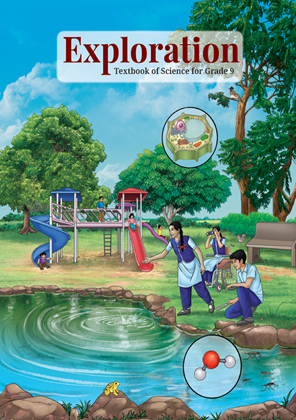
What Is Exploration and Why Has the Science Textbook Changed?
The name Exploration reflects the new approach NCERT has adopted for science education. Rather than treating science as a collection of facts to be memorised, the textbook encourages students to think like young scientists—asking questions, making observations, analysing evidence, and understanding how scientific knowledge develops.
Students familiar with the traditional method of learning science through definitions, notes, and textbook exercises will notice a clear difference. The new textbook focuses more on curiosity, critical thinking, and active participation in the learning process.
One of the most noticeable changes is the inclusion of several innovative learning features throughout the chapters. Students will find thought-provoking questions at the beginning of each chapter, regular self-assessment activities, interesting fact boxes, real-life examples, and sections that encourage deeper exploration of scientific concepts. Some topics have also been designed to help students build a stronger foundation for future competitive examinations.
The scope of the textbook has also expanded significantly. In addition to Physics, Chemistry, and Biology, the new curriculum introduces Earth Science as an important area of study. This addition helps students better understand natural processes, environmental changes, and the world around them, making science more connected to everyday life.
Overall, Exploration represents a modern and engaging approach to science education, aimed at developing curiosity, scientific thinking, and a deeper understanding of how science shapes our world.
What’s New, What’s Removed, and What’s Changed in the New Class 9 Science Book?
The new Exploration: Textbook of Science for Grade 9 introduces several important changes to the NCERT Science curriculum. Some topics from the previous textbook have been removed, some have been reorganised, and several new concepts have been added to make learning more relevant and engaging.
Topics Removed from Class 9:-
A few chapters that were part of the earlier NCERT Science textbook are no longer included in Class 9. Topics such as Gravitation, Natural Resources, and Improvement in Food Resources have been removed from the syllabus at this level. These changes allow students to focus on foundational concepts before studying more advanced topics in higher classes.
New and Expanded Topics:-
The chapter on Work and Energy has been expanded into Work, Energy and Simple Machines. Along with energy concepts, students now learn about simple machines such as levers, pulleys, and inclined planes, helping them understand how these devices make everyday work easier.
Another significant change is the introduction of Reproduction in Class 9, a topic that was previously studied in higher classes. The textbook also includes a new chapter on Diversity and Classification, which helps students understand the variety of living organisms and the scientific methods used to classify them.
A Completely New Addition: Earth Science:-
One of the most exciting features of the new curriculum is the inclusion of Earth Science. The chapter “Earth as a System” introduces students to the Earth’s major components—the atmosphere, hydrosphere, lithosphere, and biosphere—and explains how they interact with one another.
Students also learn about the Sun as the primary source of energy for Earth, along with important natural cycles such as the water cycle, carbon cycle, nitrogen cycle, and oxygen cycle. These concepts help build an understanding of environmental processes and the interconnected nature of life on Earth.
Why These Changes Matter –
The updated curriculum aims to make science more meaningful, interdisciplinary, and connected to real-world situations. By introducing new topics and modern learning approaches, NCERT seeks to develop scientific thinking, curiosity, and a deeper understanding of the natural world among students.
Chapter-Wise Overview: What You’ll Study in Exploration
Chapter 1 – Exploration: Entering the World of Secondary Science
This opening chapter introduces students to the world of science and the way scientists investigate questions about the natural world. It explains concepts such as observation, measurement, variables, and the scientific method. Although it is different from a typical content-based chapter, it lays the foundation for understanding the topics covered throughout the book.
Chapter 2 – Cell: The Building Block of Life
Students begin their study of biology by learning about cells, the basic units of life. The chapter covers cell structure, cell organelles, plant and animal cells, and the differences between prokaryotic and eukaryotic cells. Diagrams play an important role in this chapter and should be practised carefully.
Chapter 3 – Tissues in Action
This chapter explains how similar cells come together to form tissues and how different tissues perform specific functions in plants and animals. It provides an important link between basic cell biology and more advanced biological concepts studied in higher classes.
Chapter 4 – Describing Motion Around Us
The first physics chapter focuses on motion and its measurement. Students learn about distance, displacement, speed, velocity, acceleration, and graphical representations of motion. These concepts help explain movement in everyday life and form the basis of many future physics topics.
Chapter 5 – Exploring Mixtures and Their Separation
This chemistry chapter introduces pure substances and mixtures. Students learn about solutions, suspensions, colloids, and various separation techniques such as filtration, evaporation, distillation, chromatography, and centrifugation. The chapter combines theory with practical applications.
Chapter 6 – How Forces Affect Motion
Students explore Newton’s Laws of Motion and their applications in daily life. The chapter discusses balanced and unbalanced forces, inertia, momentum, and the relationship between force and motion. These concepts are fundamental to understanding mechanics.
Chapter 7 – Work, Energy and Simple Machines
This chapter explains work, energy, power, and the law of conservation of energy. It also introduces simple machines such as levers, pulleys, and inclined planes, showing how they help make work easier and more efficient.
Chapter 8 – Journey Inside the Atom
Students learn about the structure of the atom, including electrons, protons, and neutrons. The chapter traces the development of atomic models proposed by scientists such as Thomson, Rutherford, and Bohr, while also introducing atomic number, mass number, isotopes, and valency.
Chapter 9 – Atomic Foundations of Matter
Building on the previous chapter, this section explains how atoms combine to form molecules and compounds. Students study the laws of chemical combination, Dalton’s Atomic Theory, atomic and molecular masses, the mole concept, and the writing of chemical formulae.
Chapter 10 – Sound Waves: Characteristics and Applications
This chapter introduces sound as a form of energy produced by vibrations. Students learn about the properties of sound waves, including frequency, wavelength, amplitude, and speed. Practical applications such as echoes, sonar, and ultrasound are also discussed.
Chapter 11 – Reproduction: How Life Continues
The chapter explains how living organisms reproduce and ensure the continuation of life. Both asexual and sexual reproduction in plants and animals are covered in a simple and student-friendly manner.
Chapter 12 – Patterns in Life: Diversity and Classification
Students explore the incredible diversity of living organisms and learn why classification is important. The chapter discusses different classification systems, taxonomic hierarchy, major groups of organisms, and scientific naming methods.
Chapter 13 – Earth as a System: Energy, Matter, and Life
The final chapter introduces Earth Science and explains how the atmosphere, hydrosphere, lithosphere, and biosphere interact with one another. Students learn about the flow of energy from the Sun, important natural cycles, and the interconnected processes that support life on Earth.
Frequently Asked Questions
Is the old Class 9 Science book still valid for 2026-27?
No. Exploration is the only valid Science textbook for Class 9 from this session. The old book’s chapters, content, and structure no longer match what CBSE schools are teaching or testing.
How many chapters does Exploration have?
Thirteen chapters covering Physics, Chemistry, Biology, and Earth Science — all in a single volume. Unlike Maths, there is no Part 2 for Science.
Is Gravitation still in Class 9?
No. The Gravitation chapter has been removed from Class 9 and shifted to higher classes.
Is Reproduction now in Class 9?
Yes. Reproduction was previously a Class 10 topic. It has been moved into Class 9 in the new curriculum, and is covered in Chapter 11 of Exploration.
What is the Earth as a System chapter about?
Chapter 13 is a completely new addition to Class 9 Science. It covers how Earth’s major systems — atmosphere, hydrosphere, lithosphere, and biosphere — interact with each other, including biogeochemical cycles and the flow of energy from the Sun. Nothing like this existed in the previous Class 9 Science book.
Is Exploration enough for JEE and NEET foundation?
As a starting point, yes. The book includes “Ready to Go Beyond” sections in each chapter specifically designed to bridge Class 9 content with competitive exam thinking. For serious JEE or NEET preparation, additional resources will be needed — but Exploration is a far stronger foundation than the old textbook was.
Is this book free to download?
Yes, completely. NCERT publishes all textbooks on behalf of the Government of India at no cost to students. All chapter links on this page are sourced from the official NCERT website.
Where can I find solutions for Exploration?
Visit our NCERT Solutions for Class 9 Science – Exploration 2026-27 page for step-by-step, chapter-wise solutions to every exercise and in-text question in the book.
A Note Before You Start
Exploration is a book that rewards students who slow down. It’s not structured for speed-reading and last-minute cramming — the questions are designed to make you think, the chapters are designed to connect, and the learning is meant to be cumulative. Students who treat it the same way they treated the old Science textbook will struggle. Students who actually read it — carefully, curiously — will find it one of the more engaging textbooks they’ve come across.
Download the chapter you need, start from Chapter 1 if you haven’t already, and give each chapter the time it deserves.
— Team Invincible Edge Academy
Related Links
-
NCERT Class 9 Maths Book Ganita Manjari Part 2 - PDF Download
-
NCERT Class 9 Social Science New Book PDF 2026-27 – Chapter Wise Download
-
NCERT Class 9 Hindi Book – Ganga PDF Download (New 2026-27 Edition)
-
NCERT Class 9 English Book – Kaveri PDF Download (2026-27)
-
NCERT Class 9 Science Book – Exploration PDF Download (2026-27) | All Chapters Free
-
NCERT Class 9 Maths Book Ganita Manjari - PDF Download