

Related Links
-
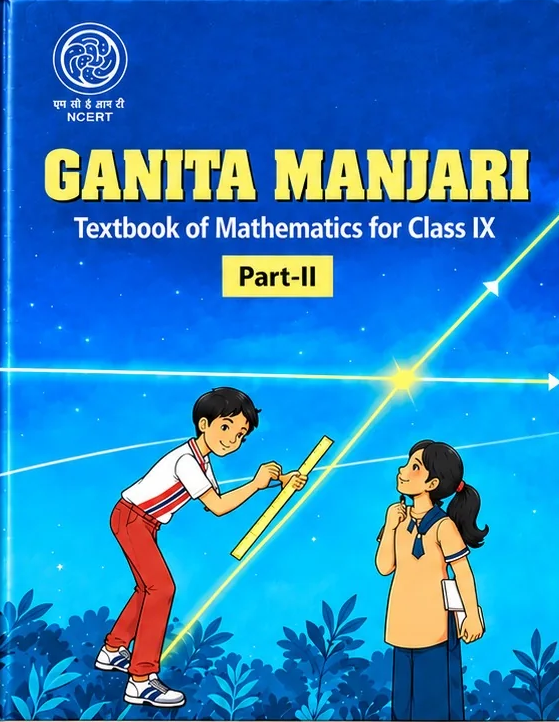
NCERT Class 9 Maths Book Ganita Manjari Part 2 - PDF Download
-
NCERT Class 9 Social Science New Book PDF 2026-27 – Chapter Wise Download
-
NCERT Class 9 Hindi Book – Ganga PDF Download (New 2026-27 Edition)
-
NCERT Class 9 English Book – Kaveri PDF Download (2026-27)
-
NCERT Class 9 Science Book – Exploration PDF Download (2026-27) | All Chapters Free
-
NCERT Class 9 Maths Book Ganita Manjari - PDF Download
NCERT Class 9 Maths Book – Ganita Manjari Part 2 PDF Download (2026-27) | All Chapters Free
If you’re looking for the Class 9 Maths NCERT book for the 2026-27 session, the book you need is no longer the old one. The new textbook is called Ganita Manjari Part 2 — and it’s a significant departure from everything Class 9 Maths used to look like.
If you’ve already gone through Ganita Manjari Part 1, you know by now that this isn’t the Class 9 Maths book you grew up hearing about from seniors. Part 2 continues in exactly that spirit — six chapters that quietly move topics you’d expect in Class 10 or 11 straight into Class 9, and ask you to actually reason your way through them instead of just applying formulas.
This page has all 6 chapters of Ganita Manjari Part 2 available as free PDF downloads — chapter-wise, straight from the official NCERT source.
Download Chapter-wise PDFs — Ganita Manjari Part 2:
For Ganita Manjari Part 1 – Click Here
What’s Different About Part 2?
If Part 1 eased you into the new way of thinking, Part 2 is where it really shows up. You’ll notice two things immediately: logic and reasoning get their own dedicated chapter for the first time (Propositions and their Converses), and an entire chapter is devoted to algorithms — a topic that didn’t exist in the old Class 9 Maths book at all. Alongside that, familiar territory like Quadrilaterals, Linear Equations, and Mensuration returns, but with more emphasis on why a result is true, not just how to use it.
Chapter-Wise Overview: What You’ll Learn in Each Chapter
Chapter 9 – Propositions and their Converses
This chapter builds the logical foundation for everything that follows in the book. You’ll learn what makes a statement a “proposition” (true or false, nothing in between), and how to form the converse of a proposition — swapping the “if” and “then” parts. The key insight this chapter drives home is that a proposition being true doesn’t guarantee its converse is true too. You’ll also learn to use counterexamples to disprove a statement — a skill that shows up repeatedly in later chapters, especially Quadrilaterals.
Chapter 10 – How Quantities Combine: Understanding Data
This is the statistics chapter, built around the weighted mean — how to calculate it, and where it’s actually useful (combining marks from different assessments, computing concentration in mixtures, averaging averages). It also covers stacked bar charts and 100% stacked bar charts, explaining when to use which: 100% stacked charts compare proportions, not absolute totals, similar to pie charts. A practical, data-literacy-focused chapter rather than a pure formula one.
Chapter 11 – The World of Algorithms
A genuinely new addition to the Class 9 syllabus. This chapter introduces algorithmic thinking — breaking a problem down into a systematic, repeatable sequence of steps. You’ll work with loops (repeating a step for each value in a range) and conditional steps (doing something only if a condition holds), using simple examples like finding divisors of a number. Importantly, the chapter also expects you to justify why an algorithm works and think about how efficient it is — not just write down steps.
Chapter 12 – Quadrilaterals
Building directly on the logic skills from Chapter 9, this chapter revisits quadrilaterals with a sharper focus on converse statements — if opposite sides are equal, is it a parallelogram? If diagonals bisect each other, is it a parallelogram? Each of these converses is proven true here. The chapter also covers the Midpoint Theorem and its converse, and introduces the centroid of a triangle (where medians meet, dividing each in a 2:1 ratio) along with properties of the quadrilateral formed by joining the midpoints of another quadrilateral’s sides. Expect a good mix of proof-based and property-based questions from this chapter.
Chapter 13 – Two Variables, One Line
This is the linear equations chapter — writing equations in the form ax + by + c = 0, understanding the slope-intercept form (y = mx + d), and recognizing that a linear equation in two variables has infinitely many solutions, each represented as a point on its graph. The chapter goes deeper into solving a pair of linear equations — algebraically (substitution and elimination methods) and graphically — and covers the three possible outcomes based on the ratio of coefficients: a unique solution (intersecting lines), no solution (parallel lines), or infinitely many solutions (coincident lines). A high-weightage, frequently tested chapter.
Chapter 14 – Math of Space: Surface Area and Volume
This chapter covers surface area and volume of solid shapes — the same core mensuration concepts that used to appear in the Class 10 syllabus, now moved up to Class 9. Expect formulas and applications for cubes, cuboids, cylinders, cones, and spheres, with an emphasis on understanding how these formulas are derived, not just memorizing them.
How to Study Ganita Manjari Part – 2 Effectively
Start with Chapter 9 seriously — don’t treat it as a “light” chapter. Propositions and their converses feel abstract at first, but the logic you build here is directly applied in Chapter 12’s quadrilateral proofs. Skipping ahead without mastering this will make Quadrilaterals harder than it needs to be.
Chapter 11 needs practice, not memorization. Algorithmic thinking is a new skill for most Class 9 students. Work through the examples step-by-step on paper, and practice explaining why each step is there — that’s what exams will test.
Chapter 13 deserves the most exam-focused attention. Linear equations in two variables is one of the most consistently tested chapters across unit tests and annual exams. Be thorough with both algebraic methods (substitution, elimination) and the graphical interpretation of unique/no/infinite solutions.
Don’t skip the “why” in Chapter 12. The converse statements about parallelograms are often asked as proof-based questions, not just fill-in-the-blank facts. Practice writing out the proof, not just recalling the result.
Chapter 14 rewards visualization. Surface area and volume problems get much easier once you can visualize the 3D shape and where each formula’s terms come from. Draw the shapes out while practicing.
For Chapters 9, 12, and 13 — prioritise. These carry the most weightage in CBSE school examinations, especially given their emphasis on logic, proofs, and equations — areas examiners consistently draw questions from.
Frequently Asked Questions
Is Ganita Manjari Part 2 a separate book from Part 1?
Yes, Part 2 continues from where Part 1 ends (Chapter 8), covering Chapters 9 to 14. Together, both parts make up the complete Class 9 Maths syllabus for the 2026-27 session.
How many chapters are in Ganita Manjari Part 2?
Six chapters — covering logic and propositions, statistics, algorithms, quadrilaterals, linear equations in two variables, and surface area & volume.
Is the Algorithms chapter new to the Class 9 syllabus?
Yes, algorithmic thinking wasn’t part of the earlier 12-chapter Class 9 Maths book. It’s a new addition introduced through Ganita Manjari.
Is Surface Area and Volume the same as what used to be in Class 10?
Largely yes — the core concepts and formulas are similar to what previously appeared in the Class 10 syllabus, now moved to Class 9 as part of the restructured curriculum.
Are there solutions available for Ganita Manjari Part 2?
Yes — visit our NCERT Solutions for Class 9 Maths – Ganita Manjari Part 2 (2026-27) page for step-by-step, chapter-wise solutions to every exercise.
Is this book free to download?
Yes. Ganita Manjari Part 2 is published by NCERT on behalf of the Government of India and is freely available to all students. All chapter links on this page are sourced directly from the official NCERT website.
.
Closing Note
Ganita Manjari Part 2 asks you to hold onto logic (Chapter 9) while learning entirely new ways of thinking (Chapter 11), and then apply both to familiar-looking topics like quadrilaterals and equations. Students who treat each chapter’s reasoning seriously — not just its formulas — will find this half of the book far more manageable than it first appears.
Download the chapters, and work through them in order — the logic from Chapter 9 shows up again sooner than you’d expect.
— Team Invincible Edge Academy