

NCERT Class 8 Maths Book – Ganita Prakash Part 1 & 2 PDF Download (2026-27) | All Chapters Free
If your Class 8 Maths teacher this year isn’t starting class with “Rational Numbers” or “Linear Equations in One Variable” — but instead opening with a locker puzzle or a story — that’s not a coincidence. NCERT has replaced the old single-volume Class 8 Maths textbook with a brand-new two-part series called Ganita Prakash.
Developed in line with NEP 2020 and NCF-SE 2023 guidelines, this new textbook moves away from rote learning and toward concept-based, activity-driven learning.
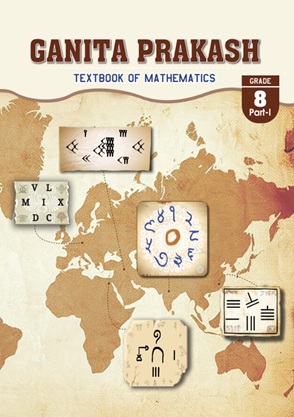
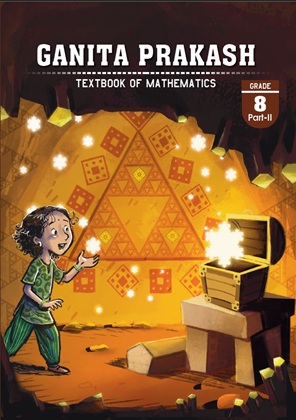
What Is Ganita Prakash and Why Has the Maths Book Changed?
“Ganita Prakash” means “Light of Mathematics” in Sanskrit — a name that itself reflects NCERT’s new approach. Rather than treating maths as a set of formulas and exercises, the textbook presents it through puzzles, stories, and real-life context.
Every chapter opens with an activity, a historical reference, or an intriguing puzzle — for instance, Chapter 1 begins with Queen Ratnamanjuri’s puzzle of 100 lockers — designed to spark curiosity before any formal mathematics is introduced.
The most significant structural change is that the old 13-chapter single book has now been split into two parts — Part 1 and Part 2, with 14 chapters in total. Another notable feature is the celebration of Indian mathematical heritage — for example, the Pythagoras Theorem is now titled “The Baudhayana-Pythagoras Theorem,” recognising the contribution of the ancient Indian mathematician Baudhayana.
What’s New, What’s Removed, and What’s Changed in Class 8 Maths?
New Chapters / New Framing:
“Power Play” (Exponents and Powers) and “A Story of Numbers” (Rational Numbers presented in historical context) are both given an entirely new framing, making them feel quite different from their counterparts in the old book.
The most significant addition in Part 2 is a dedicated chapter — The Baudhayana-Pythagoras Theorem — which teaches students how to find the sides of right-angle triangles while also covering its Indian origins.
Topics That Were Merged or Restructured:
In the old book, Square and Square Roots and Cube and Cube Roots were separate chapters; they’ve now been combined into a single chapter, “A Square and A Cube.” Similarly, Direct and Inverse Proportions has been split into “Proportional Reasoning – 1” and “Proportional Reasoning – 2,” covered across Part 1 and Part 2 respectively.
New Naming Style:
The old “Algebraic Expressions and Identities” chapter has now been reworked into “We Distribute, Yet Things Multiply” and “Algebra Play” — reflecting a more engaging, conceptual approach.
Chapter-Wise Overview: What You’ll Study in Ganita Prakash
Chapter 1 – A Square and A Cube
Explains perfect squares, perfect cubes, square roots, and cube roots through puzzles and patterns. The chapter opens with a locker puzzle that connects factors to perfect squares.
Chapter 2 – Power Play
Introduces exponents and powers — how numbers grow exponentially when multiplied by themselves repeatedly. Covers standard form, scientific notation, and real-world examples like astronomical distances.
Chapter 3 – A Story of Numbers
Introduces rational numbers through historical and cultural context, tracing how number systems evolved.
Chapter 4 – Quadrilaterals
Focuses on types of quadrilaterals — rectangles, squares, parallelograms, trapeziums — and their properties, exploring relationships between angles, sides, and diagonals.
Chapter 5 – Number Play
Explores number patterns, riddles, and logical reasoning, including divisibility and number tricks.
Chapter 6 – We Distribute, Yet Things Multiply
Introduces the distributive property of multiplication and algebraic expressions — how multiplication distributes over addition.
Chapter 7 – Proportional Reasoning – 1
Covers the basic relationship between ratios and proportions — how two quantities can be compared and related.
Chapter 8 – Fractions in Disguise
Explores rational numbers in fractional form at a deeper level, including simplification and operations.
Chapter 9 – The Baudhayana-Pythagoras Theorem
Covers the theorem for finding the sides of right-angle triangles, along with its historical Indian origins (Baudhayana).
Chapter 10 – Proportional Reasoning – 2
Continues direct and inverse proportion with practical, real-life examples.
Chapter 11 – Exploring Some Geometric Themes
A deeper exploration of shapes, angles, and geometrical concepts, strengthening the foundation in geometry.
Chapter 12 – Tales by Dots and Lines
Covers graphs and data representation — coordinates, plotting, and reading line graphs.
Chapter 13 – Algebra Play
Teaches how to construct and solve algebraic expressions and equations, presenting algebra in an engaging way.
Chapter 14 – Area
Covers calculating the area of various geometrical figures (triangles, rectangles, circles) along with formulas and applications.
Frequently Asked Questions
Is the old Class 8 Maths book still valid for 2026-27?
No. Ganita Prakash Part 1 & Part 2 are the only valid textbooks for Class 8 this session. The old single-volume book no longer matches what CBSE schools are currently teaching.
How many chapters does Ganita Prakash have in total?
14 chapters in total — 7 in Part 1 and 7 in Part 2.
Is the Pythagoras Theorem now part of Class 8?
Yes. “The Baudhayana-Pythagoras Theorem” is Chapter 2 of Part 2 (overall Chapter 9), and it also covers its historical Indian roots.
Is this book free to download?
Yes, completely free. NCERT publishes these textbooks on behalf of the Government of India. All chapter links on this page are sourced from the official NCERT website.
Where can I find solutions for Ganita Prakash?
Visit our NCERT Solutions for Class 8 Maths – Ganita Prakash 2026-27 page for step-by-step solutions to every exercise and in-text question.
Related Links
-
NCERT Class 8 Sanskrit Book – Deepakam PDF Download (2026-27) | All Chapters Free
-
NCERT Class 8 Social Science Book – Exploring Society: India and Beyond PDF Download (2026-27)
-
NCERT Class 8 Hindi Book – Malhar PDF Download (2026-27) | All Chapters Free
-
NCERT Class 8 English Book – Poorvi PDF Download (2026-27) | All Chapters Free
-
NCERT Class 8 Science Book – Curiosity PDF Download (2026-27) | All Chapters Free
-
NCERT Class 8 Maths Book – Ganita Prakash Part 1 & 2 PDF Download (2026-27)