

NCERT Class 8 Social Science Book – Exploring Society: India and Beyond Part 2 PDF Download
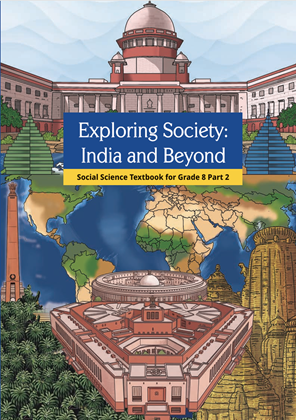
NCERT has released Part 2 of the new integrated Class 8 Social Science textbook, Exploring Society: India and Beyond. This continues from Part 1 and carries forward the same five-theme structure, taking students further into world geography, India’s freedom movement, architecture, governance, and economic life.
Social Science for CBSE Class 8 now uses Exploring Society: India and Beyond in two parts — Part 1 and Part 2 — together covering History, Geography, Civics, and Economics in a single integrated framework rather than three separate books.
Download Chapter-wise PDFs — Exploring Society: India and Beyond Part 2 (Class 8 SST)
Theme A – India and the World: Land and the People
| Chapter | Title |
|---|---|
| Chapter 1 | World Geography: Some Glimpses |
Theme B – Tapestry of the Past
Looking back and forward…
| Chapter | Title |
|---|---|
| Chapter 2 | India’s Long Road to Independence |
Theme C – Our Cultural Heritage and Knowledge Traditions
| Chapter | Title |
|---|---|
| Chapter 3 | A Journey Through Indian Architecture |
Theme D – Governance And Democracy
| Chapter | Title |
|---|---|
| Chapter 4 | The Role of the Judiciary in Our Society |
| Chapter 5 | Citizenship: Rights and Duties |
Theme E – Economic Life Around Us
| Chapter | Title |
|---|---|
| Chapter 6 | Dynamics of Population |
| Chapter 7 | India’s Urban Landscape |
| Chapter 8 | Cultural Currents: 13th to 17th Centuries |
What Is Exploring Society Part 2 and How Is It Different from Part 1?
Part 2 picks up the same five themes introduced in Part 1 — India and the World, Tapestry of the Past, Our Cultural Heritage and Knowledge Traditions, Governance and Democracy, and Economic Life Around Us — and takes each of them further rather than starting new ones. Students who studied natural resources, the Marathas, and India’s electoral system in Part 1 now move on to world geography, the freedom struggle, Indian architecture, the judiciary, citizenship, population, and urbanisation.
With 8 chapters, Part 2 is noticeably longer than Part 1’s 7 chapters, and as students approach the Secondary Stage, several chapters carry more text than earlier textbooks did — a deliberate shift NCERT has built in to prepare students for the reading demands of Classes 9 and 10.
What’s New in Part 2
History moves into the modern era: After Part 1 covered the Marathas and the early colonial period, Chapter 2, “India’s Long Road to Independence,” takes the story forward into the freedom movement itself.
A dedicated chapter on Indian architecture: Chapter 3 introduces Theme C — Our Cultural Heritage and Knowledge Traditions — for the first time in the Class 8 syllabus, tracing Indian architectural styles as a strand of cultural heritage rather than folding it into history.
The judiciary chapter has a notable backstory: Chapter 4, “The Role of the Judiciary in Our Society,” was specifically rewritten by a committee set up by the Ministry of Education, acting on directions from the Supreme Court of India in a Suo Motu Writ Petition, with academic support from a National Law University professor. The rewrite followed an NCERT order dated 16th March 2026, and the Council has formally acknowledged both the committee’s work and the academic support behind it — making this one of the more closely scrutinised chapters in the new syllabus.
Population and urbanisation join Economics: Chapters 6 and 7 — Dynamics of Population and India’s Urban Landscape — extend Theme E beyond Part 1’s single chapter on Factors of Production, giving Economics a much bigger footprint in Class 8 than before.
A second cultural-history chapter closes the book: Chapter 8, “Cultural Currents: 13th to 17th Centuries,” rounds off Part 2 by returning to cultural history, tracing the interactions, traditions, and ideas that shaped Indian society across that period.
Frequently Asked Questions
Is Part 2 compulsory along with Part 1 for the 2026-27 session? Yes. Exploring Society: India and Beyond is published in two parts for Class 8, and together they form the complete CBSE-prescribed Social Science syllabus for the year — Part 2 is not optional or supplementary.
How many chapters does Part 2 have? Part 2 has 8 chapters spread across four of the five overall themes — India and the World, Tapestry of the Past, Our Cultural Heritage and Knowledge Traditions, Governance and Democracy, and Economic Life Around Us.
Does Part 2 continue directly from Part 1, or are the chapters numbered separately? The themes carry over, but chapter numbering restarts at Chapter 1 in Part 2, so each part should be studied as its own set of chapters within the shared five-theme framework.
Is this book free to download? Yes, completely free. NCERT publishes all textbooks on behalf of the Government of India, and all chapter links on this page are sourced from the official NCERT website.
Where can I find solutions for Exploring Society Part 2? Visit our NCERT Solutions for Class 8 Social Science – Exploring Society Part 2 (2026-27) page for chapter-wise answers, map-based questions, and explanations for every exercise.
Related Links
-
NCERT Class 9 Social Science New Book PDF 2026-27 – Chapter Wise Download
-
NCERT Class 9 Hindi Book – Ganga PDF Download (New 2026-27 Edition)
-
NCERT Class 9 English Book – Kaveri PDF Download (2026-27)
-
NCERT Class 9 Science Book – Exploration PDF Download (2026-27) | All Chapters Free
-
NCERT Class 9 Maths Book Ganita Manjari - PDF Download
-
NCERT Books for Class 9 New 2026-27 Edition – Free PDF Download All Subjects
Recent posts
-
Class 12 Commerce NCERT Books & Solutions – All Subjects
-
Class 11 Commerce NCERT Books & Solutions – All Subjects
-
NCERT Class 8 Social Science New Book – Exploring Society: India and Beyond Part 2 PDF Download
-
NCERT ENGLISH BOOK CLASS 6TH
-
NCERT Class 9 Social Science New Book PDF 2026-27 – Chapter Wise Download