

NCERT Class 9 Social Science Part 2 PDF Download (2026-27) | Understanding Society: India and Beyond – All Chapters Free
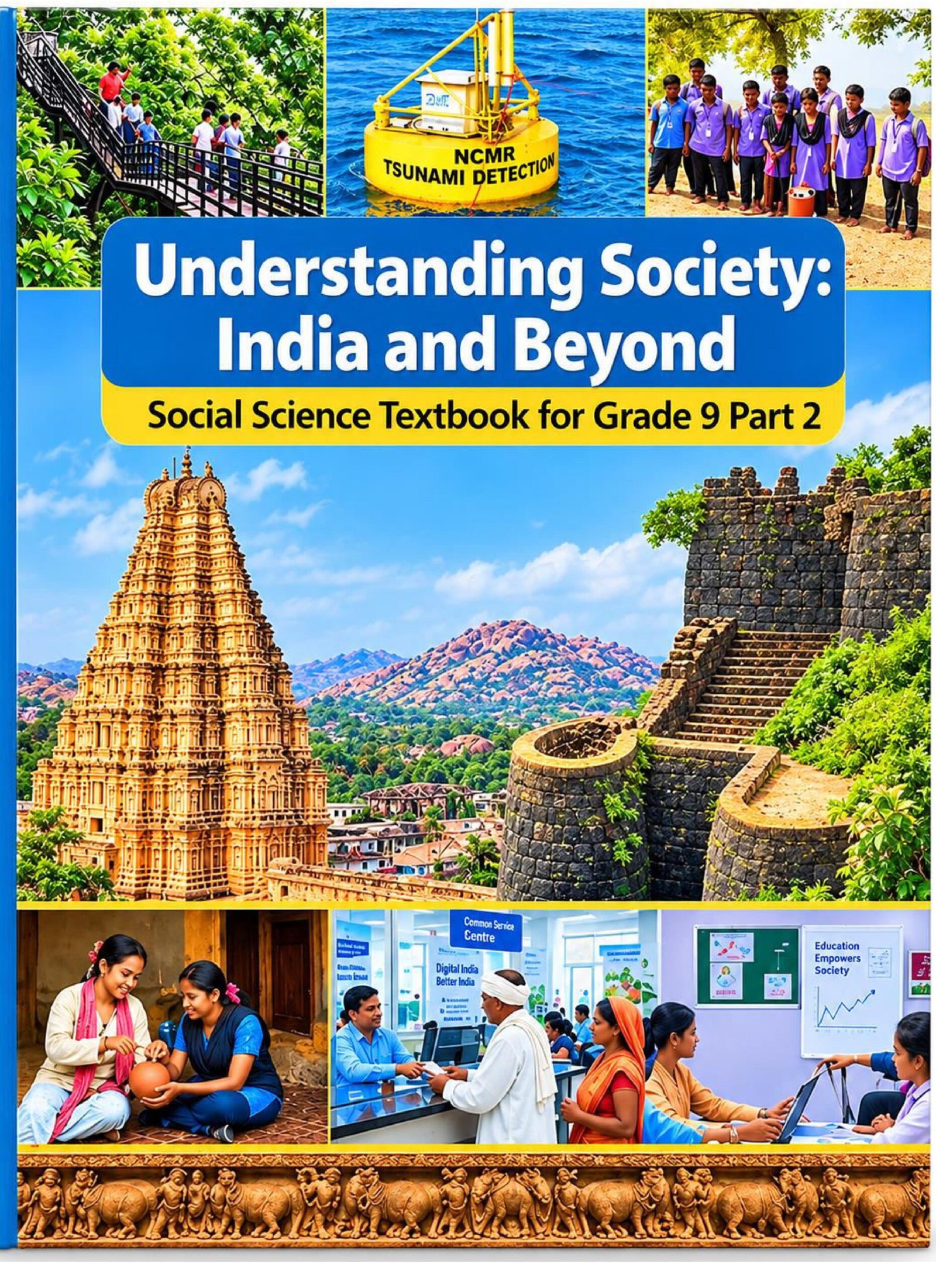
If you’re searching for the Class 9 Social Science NCERT book for the 2026-27 session, the textbook is Understanding Society: India and Beyond, and Part 2 has now been released. It brings together Geography, History, Political Science and Economics in a single book, and the chapter titles show how different this book is from the old four-book setup.
This page has all 6 chapters of Part 2 available as free PDF downloads, chapter-wise, linked to the official NCERT source.
Download Chapter-wise PDFs: Understanding Society: India and Beyond Part 2
What’s Different About Part 2?
Earlier, Class 9 Social Science meant separate books for History, Geography, Civics and Economics. Now all four subjects sit in one integrated textbook, split into two parts. Part 2 has two Geography chapters, one History chapter, one Political Science chapter and two Economics chapters.
A few things stand out. History is now one long chapter covering about 700 years (1000–1700 CE). Economics moves away from pure theory towards practical life skills: personal finance and startups. Political Science looks at how governments actually make and run policies.
Chapter-Wise Overview: What You’ll Learn in Each Chapter
Chapter 1 – Oceans and Life (Geography)
This chapter introduces the ocean floor and its relief features. It then explains the movement of ocean water: waves, tides and ocean currents. Expect to learn what causes each movement and how they affect coastlines, climate and the life of people living near the sea. Diagrams matter a lot here, so practise drawing and labelling them.
Chapter 2 – Life on Earth (Geography)
This chapter is about biomes, the large natural regions defined by their climate, plants and animals. You’ll study how biomes are distributed across the world and what characterises each one. It also covers biosphere reserves in India. Map-based questions come from this chapter, so keep an outline map handy.
Chapter 3 – Resistance and Resilience, 1000–1700 CE (History)
This chapter covers medieval India, from the Delhi Sultanate through Mughal rule, and how different regions and communities responded to the political changes of the time. As the textbook presents it, the responses of regional powers include the Rajputs, Ahoms, Vijayanagara rulers, Marathas (including the concept of Swarajya), Sikhs and Jats. The chapter looks at resistance in both military and cultural forms, alliances and confederacies, and the place of the Bhakti tradition in India’s religious and spiritual history. It is a long chapter with many names, places and dates, so a timeline helps.
Chapter 4 – Governance and Public Policy (Political Science)
This chapter looks at how a government governs: how public policies are made, who is involved, and how they affect ordinary people. It connects what you studied about democracy and elections in Part 1 with how decisions are actually taken and implemented. In revised editions it replaces the older chapter titled “Authority”.
Chapter 5 – Managing Your Personal Finances (Economics)
A practical chapter on why handling money well matters in daily life. It deals with everyday ideas such as income, spending, saving and planning. Examiners tend to prefer application-based and case-based questions from chapters like this, so connect each concept to a real-life example.
Chapter 6 – From Ideas to Startups (Economics)
This chapter covers India’s start-up ecosystem: how an idea becomes a business. It also covers the Make in India initiative and the role of MSMEs and the unorganised sector in India’s economic growth. Keep in mind the difference between formal and informal sectors, because it is a favourite for short-answer questions.
How to Study Understanding Society: India and Beyond Part 2 Effectively
Split your time by subject, not by chapter number. Geography (Ch 1–2) is diagram and map heavy, History (Ch 3) is memory and sequence heavy, and Political Science and Economics (Ch 4–6) reward clear understanding and examples. Each needs a different method.
Draw, don’t just read, in Geography. Practise ocean relief, wave, tide and current diagrams, and mark biomes on a world map. Examiners reward neat, labelled diagrams.
Build a timeline for Chapter 3. Make a simple chart of region, ruler or community, and key events. This keeps the 700-year span from becoming confusing, and it makes revision much faster.
Use real examples in Chapters 4 to 6. For governance, pick a government scheme you know. For personal finance, make a small monthly budget. For startups, name one Indian startup and trace its journey from idea to business. Examples make answers stand out.
Read the textbook line by line first. In the new NCERT books, the main text, the “think about it” boxes and the activities all feed into questions. Don’t jump straight to the exercises.
Revise Part 1 alongside Part 2. Chapters like Governance and Public Policy build on democracy and elections from Part 1.
Frequently Asked Questions
How many chapters are there in Class 9 Social Science Part 2?
Six chapters: two in Geography, one in History, one in Political Science and two in Economics.
What is the name of the NCERT Class 9 Social Science book for 2026-27?
The book is called Understanding Society: India and Beyond, released in two parts.
Which period does the History chapter in Part 2 cover?
Chapter 3, Resistance and Resilience, covers the period from 1000 CE to 1700 CE.
What does the Geography section of Part 2 cover?
Chapter 1 covers ocean relief, waves, tides and currents, and Chapter 2 covers biomes and biosphere reserves in India.
What topics are in the Economics chapters?
Chapter 5 is about managing personal finances, and Chapter 6 is about startups, Make in India, MSMEs and the unorganised sector.
Are NCERT solutions available for Part 2?
Yes. Visit our NCERT Solutions for Class 9 Social Science Part 2 page for chapter-wise solutions (link to your solutions page).
Is this book free to download?
Yes. The book is published by NCERT and is free for all students. All chapter links on this page point to the official NCERT website.
Closing Note
Understanding Society: India and Beyond Part 2 asks you to switch between maps, timelines and real-life examples within a single book. Students who match their study method to each subject will find it much more manageable. Download the chapters, start with the subject you find hardest, and revise a little every week.
— Team Invincible Edge Academy
Related Links
-
Class 9 Social Science Part 2 PDF (2026-27) - Understanding Society India and Beyond NCERT
-
NCERT Class 9 Maths Book Ganita Manjari Part 2 - PDF Download
-
NCERT Class 9 Social Science New Book PDF 2026-27 – Chapter Wise Download
-
NCERT Class 9 Hindi Book – Ganga PDF Download (New 2026-27 Edition)
-
NCERT Class 9 English Book – Kaveri PDF Download (2026-27)
-
NCERT Class 9 Science Book – Exploration PDF Download (2026-27) | All Chapters Free