

NCERT Class 8 Social Science Book – Exploring Society: India and Beyond PDF Download (2026-27) | All Chapters Free
If your Class 8 Social Science teacher this year isn’t handing out three separate books for History, Geography, and Civics — but is instead opening a single textbook and talking about natural resources, the Maratha Empire, and Parliament all in the same course — that’s not a shortcut. That’s the new design.
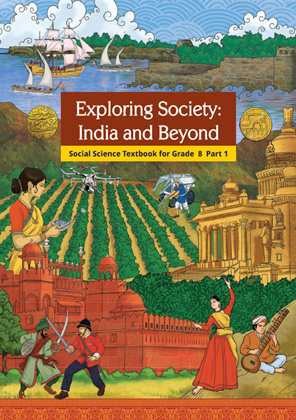
NCERT has replaced the old three-book structure (Our Pasts III, Resources and Development, Social and Political Life III) with a single integrated textbook called Exploring Society: India and Beyond.
Social Science for CBSE Class 8 now uses the integrated NCERT textbook “Exploring Society: India and Beyond,” which includes History, Geography, Civics, and Economics in one book. The updated syllabus helps students draw parallels between history and contemporary society, comprehend geographical phenomena, and reflect upon governance and economics.
Download Chapter-wise PDFs — Exploring Society: India and Beyond (Class 8 SST)
Theme A – India and the World: Land and the People
| Chapter | Title |
|---|---|
| Chapter 1 | Natural Resources and Their Use |
Theme B – Tapestry of the Past
| Chapter | Title |
|---|---|
| Chapter 2 | Reshaping India’s Political Map |
| Chapter 3 | The Rise of the Marathas |
| Chapter 4 | The Colonial Era in India |
Theme D – Governance and Democracy
| Chapter | Title |
|---|---|
| Chapter 5 | Universal Franchise and India’s Electoral System |
| Chapter 6 | The Parliamentary System: Legislature and Executive |
Theme E – Economic Life Around Us
| Chapter | Title |
|---|---|
| Chapter 7 | Factors of Production |
What Is Exploring Society and Why Has the Social Science Book Changed?
In Class 8 Social Science, students explore more aspects of India across five themes — India and the World: Land and the People, Tapestry of the Past, Our Cultural Heritage and Knowledge Traditions, Governance and Democracy, and Economic Life Around Us.
This thematic framework is the most significant structural shift. The old system treated History, Geography, and Civics as three separate subjects with three separate books. The new Exploring Society textbook organises all of these into unified themes — so a student studying the Colonial Era in the same book as India’s Electoral System begins to see connections between past and present that the old format never made visible.
Each chapter begins with an inspiring quotation from a renowned person or text. Technical words are explained in the margin right next to the text and are also listed in a glossary at the end of the textbook. “The Big Questions,” between three and five per chapter, give students an idea of what they are going to explore.
What’s New, What’s Removed, and What’s Changed in Class 8 Social Science?
Old Books Replaced:
Three separate books — Our Pasts III (History), Resources and Development (Geography), and Social and Political Life III (Civics) — have all been replaced by a single integrated volume: Exploring Society: India and Beyond. Students using the old books are no longer following the current CBSE syllabus.
New Integrated, Thematic Structure:
Instead of covering History, Geography, Civics, and Economics as isolated disciplines, Exploring Society groups content under five big themes. This means a chapter on natural resources sits alongside chapters on historical empires and democratic governance — helping students see how land, power, and society are always connected.
New Content Added — Indian History Reframed:
Chapter 3, “The Rise of the Marathas,” is a notable addition that gives significant attention to Chhatrapati Shivaji Maharaj, the Peshwas, and the Maratha Confederacy — a chapter that celebrates Indian political and military heritage with greater depth than the old curriculum.
Economics Now Formally Included:
The NCERT Class 8 Social Science syllabus now encompasses History, Geography, Civics, and Economics. Each subject builds upon foundational concepts while introducing students to contemporary issues relevant to India’s development. Economics was not a standalone focus in the old Class 8 books; Chapter 7 on Factors of Production gives it formal recognition for the first time at this level.
“Big Questions” Approach:
Rather than simply presenting facts to memorise, each chapter in Exploring Society opens with 3–5 big questions that frame the chapter’s inquiry — a direct reflection of NEP 2020’s shift from rote learning to analytical thinking.
Frequently Asked Questions
Are the old Class 8 Social Science books (Our Pasts III, Resources and Development, Social and Political Life III) still valid for 2026-27?
No. All three old books have been replaced by the single integrated textbook Exploring Society: India and Beyond. Students using the old books are no longer studying the current CBSE-prescribed syllabus.
How many chapters does Exploring Society (Class 8) have?
Part 1 of Exploring Society has 7 chapters covering natural resources, Indian political history, governance, and economics. An advisory from NCERT regarding Part 2 is expected — check the official NCERT website for updates on the complete chapter list.
Is the Pythagoras Theorem-style approach used in Social Science too?
Yes, in the sense that Exploring Society follows the same NEP 2020 philosophy as all new NCERT books — it opens chapters with big questions, uses primary sources and maps throughout, and asks students to think and analyse rather than simply memorise dates and definitions.
Does this book cover History, Geography, Civics, and Economics all together?
Yes. The NCERT Class 8 Social Science syllabus encompasses four major subjects — History, Geography, Civics, and Economics — all integrated within the Exploring Society textbook, so students gain a holistic perspective on how societies function and evolve.
Is this book free to download?
Yes, completely free. NCERT publishes all textbooks on behalf of the Government of India. All chapter links on this page are sourced from the official NCERT website.
Where can I find solutions for Exploring Society?
Visit our NCERT Solutions for Class 8 Social Science – Exploring Society 2026-27 page for chapter-wise answers, map-based questions, and explanations for every exercise.
Related Pages
- NCERT Class 8 English Book – Poorvi PDF Download (2026-27) | All Chapters Free
- NCERT Class 8 Hindi Book – Malhar PDF Download (2026-27) | All Chapters Free
- NCERT Class 8 Maths Book – Ganita Prakash Part 1 & 2 PDF Download (2026-27)
- NCERT Class 8 Sanskrit Book – Deepakam PDF Download (2026-27) | All Chapters Free
- NCERT Class 8 Science Book – Curiosity PDF Download (2026-27) | All Chapters Free
- NCERT Class 8 Social Science New Book – Exploring Society: India and Beyond Part 2 PDF Download